
Spanda, the Flower of Life, and the Śrī Yantra
— ✦ —
There are two sacred diagrams that have travelled across civilisations, each holding, in the silent language of geometry, something that language can only approach obliquely. The Flower of Life and the Śrī Yantra are not merely symbols. They are enactments. To look at them with genuine attention is to witness the very process they depict: the pulsation of consciousness into form and back into itself, the movement that the Trika tradition of Kashmir Śaivism names spanda.
This essay holds both diagrams together, not to collapse their differences, but to let each illuminate what the other cannot show. Between them, they triangulate something that neither can express alone: the full arc of spanda, from its undirected primordial abundance to its most concentrated, intentional depth.
Part I: The Flower of Life: Spanda as Pure Pulse
The Pattern That Breathes
Look at the Flower of Life long enough and something strange happens. What appears at first to be a static diagram, circles nested within circles, a repeating tessellation of crystalline precision, begins to move. Not metaphorically. The eye finds it impossible to settle. Every centre becomes a periphery; every periphery conceals a new centre. The pattern refuses to be fixed.
This is not a defect of perception. It is the pattern’s deepest truth.
In the Trika understanding, spanda, the sacred tremor, the primordial vibration, is not something added to consciousness. It is the very nature of Śiva’s self-recognition. Abhinavagupta describes it as the subtle pulsation, sphūratā, by which pure awareness simultaneously contracts into apparent multiplicity and expands back into its own undivided luminosity. It is not a movement within stillness. It is the movement that is stillness, when seen from inside the seeing. The Flower of Life enacts precisely this.
Vesica Piscis: The First Tremor
Begin where the geometry begins: two circles of identical radius, overlapping so that the circumference of each passes through the centre of the other. The shared region, the vesica piscis, is the first act of differentiation that does not destroy unity. Neither circle has moved. And yet something new has appeared: an in-between, a zone that belongs to both and to neither.
This is the geometrical image of spanda’s first pulse. Śiva does not split into two things. He vibrates, and in that vibration, a relational space opens. The vesica is not a product. It is the relation itself, made visible.
The Spanda Kārikās speak of the recognition, pratyabhijñā, that occurs when awareness notices its own pulsation; not as an event in time, but as the timeless condition of its own dynamism. The vesica is that noticing: the moment the circle recognises that it contains another centre without ceasing to be itself.
The Sixfold Flowering: Svātantrya in Structure
From the vesica, six further circles arrange themselves naturally around the original, not by imposition, but by geometric necessity. Each new circle is simultaneously cause and effect of its neighbours. No circle precedes another in any absolute sense; each is the condition of possibility for the whole.
This is svātantrya, the absolute freedom of Śiva, expressed as structural inevitability. The paradox that Trika holds without flinching: the divine is utterly free, and from that freedom issues a cosmos that appears completely lawful. Contingency and necessity are not opposites. They are the inhale and exhale of the same pulse.
The sixfold symmetry is not arbitrary. Six is the first number in which a circle can be perfectly tiled by circles of its own radius; the geometry of self-similarity without self-repetition. Each iteration is the same principle at a new scale, yet nothing merely copies itself. Abhinavagupta’s emanation schema in the Tantrāloka works the same way: each tattva is Śiva recognising himself at a new level of apparent contraction, yet each level is fully, completely Śiva.
The Infinite Regress That Is Not Regress
Extend the Flower of Life outward and something vertiginous occurs. There is no natural boundary. Every edge of the pattern is simply a place where the drawing stopped; the geometry itself demands continuation. And yet, every sub-region of the pattern contains the whole pattern in miniature. The Flower of Life is fractal before fractals were named.
Spanda operates identically. The tremor is not located at the macro-level of cosmic emanation and absent at the level of a breath, a heartbeat, a thought flickering into awareness. The same vibration operates at every scale. Kṣemarāja, in his commentary on the Spanda Kārikās, is explicit: the spanda recognised in the intensity of extreme states, rage, delight, the moment before sleep, is the very same pulsation that sustains the cosmos. Scale is a feature of māyā’s architecture. The vibration itself is scale-invariant.
Stillness at the Centre, Movement at Every Point
In the Flower of Life, every intersection point, every node where circumferences cross, is simultaneously a point of maximum constraint and maximum potential. From each such point, multiple arcs depart in multiple directions. The node is, in a sense, frozen; and yet it is the condition from which all movement flows.
Spanda doctrine calls this viśrānti, the rest or repose that is not inertia but fullness. The absolute stillness of Śiva is not the stillness of a stone. It is the stillness of a point so saturated with potential that all directions of movement are equally available; already present, already actual, in a mode that transcends the sequential logic of first this, then that. The Flower of Life is not a picture of creation having happened. It is a picture of creation as it is always happening.
Part II: The Śrī Yantra: Spanda Made Directional
Where the Two Patterns Part Ways
The Flower of Life is democratic. Every circle is equal in radius, equal in dignity. No centre is more central than any other. It proliferates outward without hierarchy, without apex, without resolution. It is spanda as pure, undirected abundance; the tremor that simply is, prior to any particular intention.
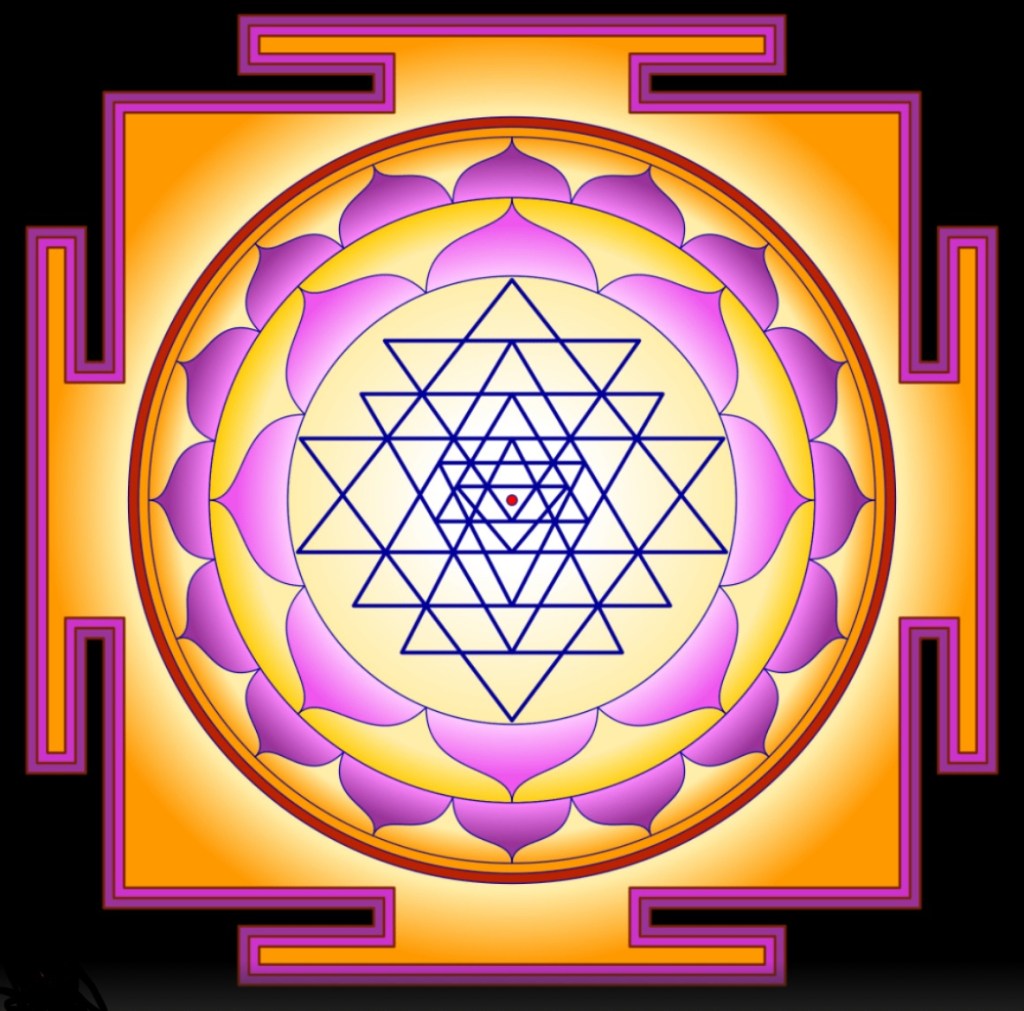
The Śrī Yantra is something else entirely. It is directed. Nine interlocking triangles, four pointing upward (Śiva, pure consciousness, the ascending movement), five pointing downward (Śakti, creative power, the descending movement), interpenetrate with such precision that their forty-three subsidiary triangles emerge not by design but by necessity. The geometry compels the result. Nobody draws the inner triangles. They appear, the way insight appears: not constructed, but disclosed.
This is the first great difference. The Flower of Life shows spanda as isotropic, vibrating equally in all directions. The Śrī Yantra shows spanda as intentional: the pulse that has a direction, a lover, a longing.
The Bindu: What the Flower of Life Cannot Show
At the absolute centre of the Śrī Yantra sits the bindu, a dimensionless point, often rendered as a small dot, around which everything else is organised. The Flower of Life has no bindu. Or rather, it has infinitely many, each circle’s centre equally valid, none privileged. This is philosophically honest about one dimension of Śiva’s nature: omnipresent, without preference, the ground that underlies equally.
But the Śrī Yantra insists on something the Flower of Life cannot quite say: that consciousness is not merely present everywhere but concentrated; that there is a movement of return, of gathering, of what Abhinavagupta calls saṃhāra, the reabsorption that is not annihilation but homecoming.
The bindu is where spanda ceases to be vibration and recognises itself as the source of vibration. It is the eye of the tremor. The stillness that is not opposed to movement but is its secret interior. In Śākta Tantra, the bindu is the union of Śiva and Śakti prior to their apparent separation: the single point of intensity from which the entire yantra unfolds outward, and toward which the entire yantra yearns inward, simultaneously.
Emanation and Return: The Yantra as Directed Breath
Read the Śrī Yantra from the bindu outward and you are reading the sṛṣṭi, emanation, the outbreath of consciousness into form. The triangles expand, the lotus petals open, the outer rings widen, until the outermost square, the bhūpura, the earth boundary, frames the whole as a world.
Read it from the outside inward and you are reading saṃhāra, dissolution, the inbreath, the return of form to its source. The meditator’s eye is drawn inward through layer after layer of decreasing complexity until the bindu swallows everything, silently, without drama.
This bidirectionality is spanda. The Spanda Kārikās are explicit: the pulse is not one-directional. It is the simultaneous movement of manifestation and reabsorption, held in a single tremor. The Flower of Life shows the horizontal dimension: the spreading, the equal dignity of every point. The Śrī Yantra shows the vertical dimension: depth, interiority, the possibility of tracing anything back to its source.
Part III: What Neither Can Show Alone
The Compulsion of the Pattern
In both cases, the geometry is not designed in the ordinary sense. The Flower of Life: once you place two circles correctly, the rest follows without choice. The Śrī Yantra: once you establish the angles of the nine triangles correctly, the forty-three inner triangles emerge by pure constraint. Neither pattern is invented. Both are discovered.
This is the geometrical image of svātantrya expressing itself as niyati, absolute freedom expressing itself as lawfulness. The cosmos is not arbitrary, yet it is not mechanically determined. It is the spontaneous self-disclosure of a consciousness that cannot help but be beautiful, cannot help but be ordered, because order and beauty are simply what it looks like when awareness recognises itself without obstruction.
The One Breath, Two Motions
Placed side by side, the two diagrams complete each other in the way that inhale and exhale complete each other: not as opposites, but as the two phases of a single act.
The Flower of Life breathes outward, endlessly, without resolution, each centre generating new peripheries, each periphery concealing new centres. It is the spanda of pure creative abundance: Śiva’s svātantrya expressing itself with no destination because it needs none.
The Śrī Yantra breathes inward, with absolute precision, each layer of complexity dissolved as the gaze moves toward the bindu. It is the spanda of recognition: Śiva’s pratyabhijñā, the self-knowing that does not add anything but removes the illusion that there was ever anything other than the source.
Together, they describe the full arc of what Abhinavagupta calls the heart of Śiva, hṛdaya, which is simultaneously the most intimate interior point and the infinite expanse of awareness. Not a metaphor, but a precision: the heart that beats is, in each beat, both the outward surge of life and the return to its own source.
Geometry as Instance, Not Metaphor
There is a temptation to say that these diagrams are metaphors for spanda, useful visual aids that point toward a truth beyond themselves. This undersells them significantly.
A metaphor says: this is like that. A sacramental form says: this is that, in a mode appropriate to perception. The Flower of Life and the Śrī Yantra do not represent spanda. They are instances of it: spanda caught in the act of organising itself into the minimum structure needed to be visible to a mind capable of looking.
To contemplate them with sustained attention is not to think about consciousness. It is to participate in the very self-recognition they depict. The looking and the looked-at collapse, slowly, into the act of looking; which is, in the Trika understanding, what spanda always was.
The Flower of Life breathes out, forever.
The Śrī Yantra breathes in, forever.
And both movements are the same breath.
 Hosshin Ananda
Leave a comment