
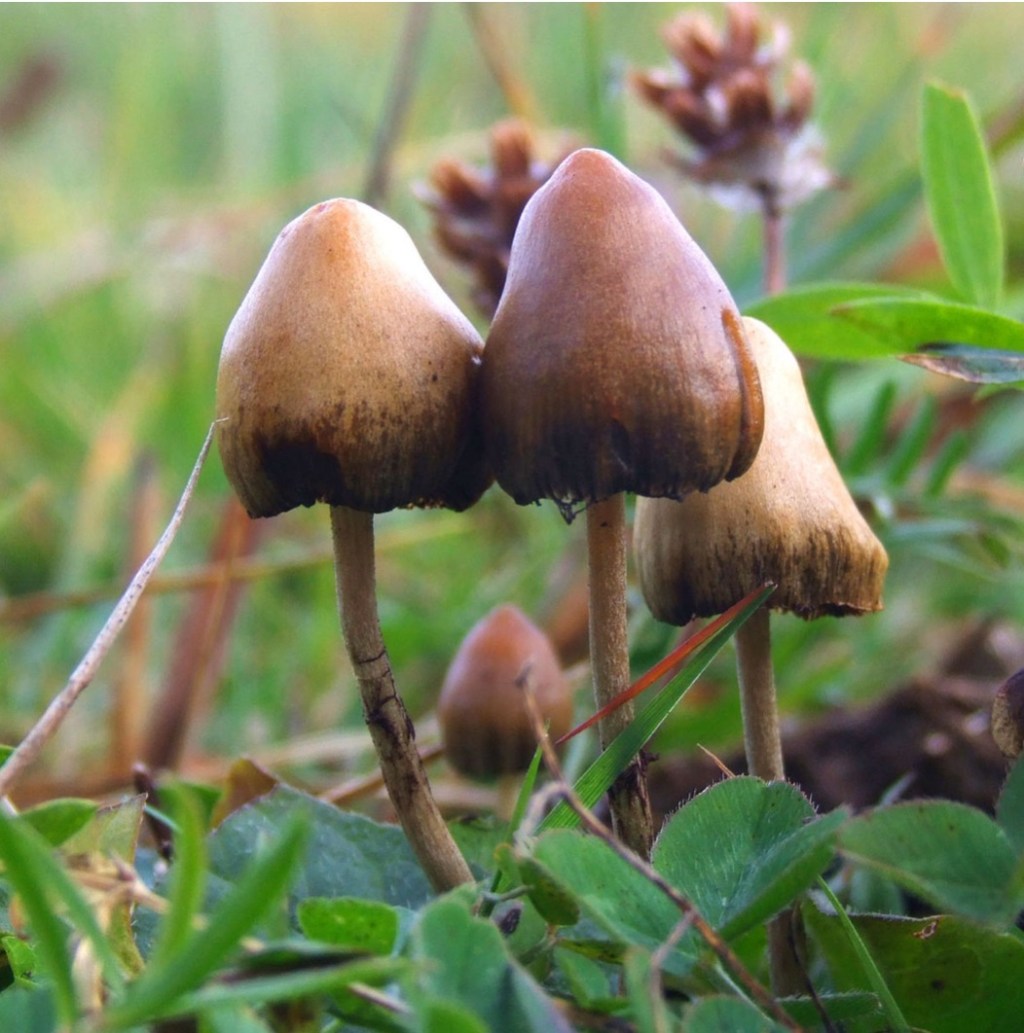
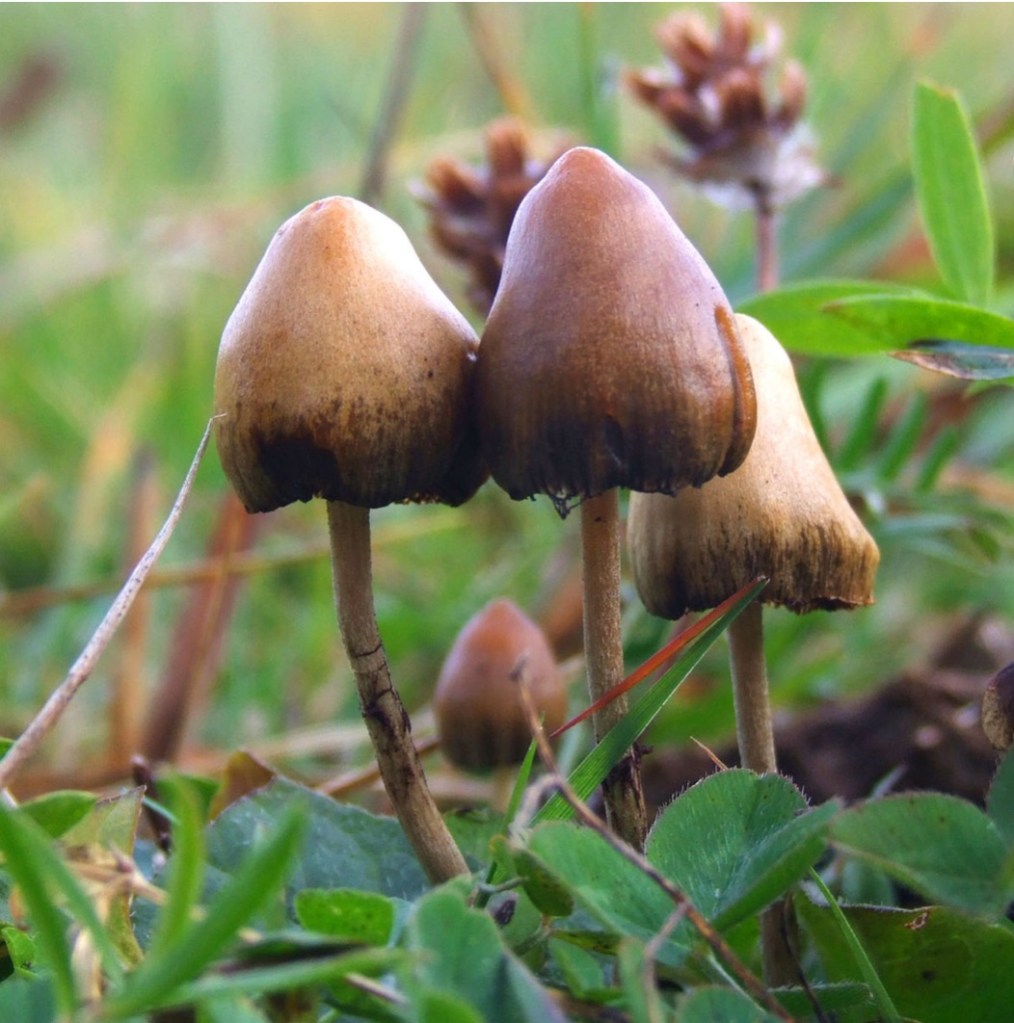
Psilocybe semilanceata
(Liberty Cap)
The slender, bell-shaped fruiting bodies pictured here are Psilocybe semilanceata, commonly known as the Liberty Cap, and among the most potent psilocybin-containing fungi found anywhere in the world. Native to cool, damp upland pastures across Northern Europe, they fruit from late summer through to early winter, emerging in clusters from the soil of ungrazed or lightly grazed grassland. In Scotland, they are a familiar presence on hillside meadows and moorland edges throughout autumn.
What the photograph shows is not merely a wild mushroom but the original source of the compound now being studied in clinical trials at Johns Hopkins, Imperial College London, and NYU for its capacity to transform depression, dissolve entrenched anxiety, process trauma, and, most recently, physically regrow damaged neural connections following stroke and nerve injury. The psilocybin contained within these small, unprepossessing caps converts in the body to psilocin, which binds to serotonin receptors and directly to the brain’s primary growth factor receptor, initiating structural changes in neural architecture that conventional medicine has no equivalent means of producing.
They have been growing on these hillsides, unnoticed by pharmacology, for millennia.
Introduction
For the better part of five decades, psychiatry operated within a relatively narrow pharmacological corridor. Antidepressants, anxiolytics, and antipsychotics offered symptomatic management for many people but left a substantial proportion without adequate relief. Treatment-resistant depression, chronic anxiety, and post-traumatic stress disorder remained among the most significant sources of human suffering for which medicine had little transformative to offer. What emerged instead were medications requiring daily use, with limited efficacy windows, difficult withdrawal profiles, and no capacity to address the underlying psychological and neurological architecture that perpetuates these conditions.
Psilocybin has re-entered this landscape not as a marginal curiosity but as a serious clinical contender, one now being studied in Phase 2 and Phase 3 trials at institutions including Imperial College London, Johns Hopkins University, NYU, and a network of sites across the United States, United Kingdom, and Australia. The data, still accumulating but already substantial, suggest that psilocybin operates differently from anything psychiatry has previously had to work with: rapidly, lastingly, and at a level that touches not just symptoms but the cognitive and emotional structures that generate them.
This essay reviews the evidence across depression, anxiety, and PTSD; examines the neurological mechanisms that explain why psilocybin works differently from conventional treatments; explores the particular terrain of existential and end-of-life distress, where the evidence is among the most compelling in all of psychedelic medicine; and addresses the practical question of dosing and therapeutic protocol.
Part One: The Neuroscience of Psychological Suffering and How Psilocybin Addresses It
The Default Mode Network and the Machinery of Rumination
To understand why psilocybin has such a distinctive effect on depression and anxiety, it is necessary to understand what these conditions look like in the brain. Both depression and anxiety are characterised, at the neurological level, by a particular kind of hyperactivity in a set of interconnected regions known as the default mode network, or DMN. This network, which includes the medial prefrontal cortex, posterior cingulate cortex, and associated areas, is active during self-referential thought: thinking about oneself, one’s past, one’s future, and one’s relationships with others.
In a healthy brain, the DMN activates and deactivates flexibly, cycling in and out of activity as attention moves between internal and external demands. In depression, the DMN becomes relatively locked in a state of excessive, rigid activity. The person is caught in repetitive self-referential loops: rumination, self-criticism, rehearsal of past failures, catastrophic projection into the future. The network does not release its grip. Crucially, this hyperactivity also tends to suppress activity in networks associated with present-moment engagement, cognitive flexibility, and the capacity for new learning.
Research from Imperial College London published in Scientific Reports in 2017 was among the first to map the brain changes following psilocybin in people with treatment-resistant depression. Using functional MRI, researchers found that psilocybin produced marked decreases in cerebral blood flow in the temporal cortex and amygdala, regions associated with the emotional intensity of negative experience. Reduced amygdala activity correlated directly with reduced depressive symptoms. Additionally, psilocybin increased connectivity within the default mode network post-treatment, suggesting a reorganisation rather than simply a suppression of activity. All 19 patients in that study showed decreased depressive symptoms one week after treatment.
A subsequent Nature Medicine paper extended this understanding, reporting that psilocybin’s antidepressant mechanism depended on a global increase in brain network integration: a loosening of the rigid boundaries between normally distinct neural networks, allowing new patterns of communication and, with them, new patterns of thought and feeling. This increased integration was not seen with escitalopram, the SSRI comparator in the same trial, suggesting that psilocybin and conventional antidepressants achieve their effects through fundamentally different neurological routes.
The REBUS Model: Loosening Rigid Predictions
A theoretical framework that has gained considerable traction in the field is the REBUS model, developed by Robin Carhart-Harris and Karl Friston at Imperial College London. REBUS stands for Relaxed Beliefs Under Psychedelics. The model proposes that much of what constitutes entrenched depression, anxiety, and PTSD is essentially a problem of overly rigid predictive coding: the brain’s tendency to filter all incoming experience through established prior beliefs, including deeply held negative beliefs about the self, the world, and the future.
In a depressed brain, the prior belief that “I am worthless” or “nothing will improve” is so dominant that it actively suppresses incoming evidence to the contrary. The brain, in effect, is not seeing clearly; it is seeing through a filter of its own historical conclusions. Psilocybin, under the REBUS model, temporarily relaxes the grip of these top-down predictions, allowing sensory and emotional information to flow more freely from the bottom up. The result is a period of heightened perceptual and emotional flexibility during which entrenched self-narratives become genuinely negotiable in a way they typically are not.
This model has direct therapeutic implications. If the brain is temporarily more open to revising its foundational beliefs about the self, then the psychological content of the experience, and the therapeutic work done before, during, and after it, becomes critically important. Psilocybin is not simply a chemical that lifts mood; it is a compound that briefly reopens a cognitive and emotional flexibility that depression, anxiety, and trauma have foreclosed.
Part Two: Depression
The Clinical Trial Landscape
The evidence base for psilocybin in depression is now among the most substantial in psychedelic medicine, encompassing open-label pilot studies, randomised controlled trials, and long-term follow-up data extending to several years.
The foundational work was conducted by Carhart-Harris and colleagues at Imperial College London. A 2016 open-label pilot study of 12 patients with treatment-resistant depression, those who had failed at least two courses of antidepressants, administered two oral doses of psilocybin one week apart, at 10mg and 25mg. Scores on multiple validated depression rating scales decreased significantly at one week and three months following treatment. Eight of the twelve patients achieved remission at one week; five of twelve maintained remission at three months. No serious adverse events occurred. The effect sizes reported were substantial, with Cohen’s d values above 2.0 at one and five weeks post-treatment, indicating a magnitude of improvement rarely seen in psychiatric pharmacology.
The landmark comparative trial, published in the New England Journal of Medicine in 2021, was the first to measure psilocybin directly against an established antidepressant. Carhart-Harris and colleagues randomised 59 patients with moderate to severe major depressive disorder to receive either two 25mg doses of psilocybin three weeks apart, or a six-week daily course of escitalopram. Both groups received psychological support throughout. At six weeks, the primary depression score outcome did not show a statistically significant difference between the two groups. However, remission rates told a more pointed story: 57 percent of the psilocybin group achieved remission, compared with 28 percent of the escitalopram group. A range of secondary outcomes, including measures of wellbeing, quality of life, and psychological flexibility, favoured psilocybin, though these were not corrected for multiple comparisons.
A secondary analysis of cognitive bias from the same trial, published in 2025, found that psilocybin therapy was superior to escitalopram in remediating the pessimistic cognitive distortions characteristic of depression. Self-reported optimism showed a large increase six weeks after psilocybin treatment; patients became more optimistic about desirable life events and improved across three domains of dysfunctional attitudes: achievement, dependency, and self-control. Escitalopram produced improvement in only one of these domains. This matters because cognitive bias is not merely a symptom of depression but one of its perpetuating mechanisms. To address it is to address the engine, not just the exhaust.
Six-month follow-up data from the same trial showed that both groups maintained improvements, with psilocybin showing superiority at the one-month follow-up point. A dose-response network meta-analysis published in ScienceDirect confirmed that the 25mg dose shows a time-dependent therapeutic effect, with efficacy building over weeks following a single or double administration, consistent with the neuroplastic changes that underlie the effect rather than a simple pharmacological action during the period of drug presence in the body.
At twelve months, research through 2025 indicates that 58 percent of patients treated with psilocybin maintain depression remission, a figure that substantially exceeds the long-term outcomes typically reported for SSRIs in treatment-resistant populations.
Real-World Data
A real-world cohort study from a Swiss university hospital, published in late 2025, tracked 115 patients with treatment-resistant depressive and anxiety disorders who received a first standardised psychedelic-assisted psychotherapy session with either 25mg psilocybin or 100 micrograms of LSD in routine clinical care. The study found that a single active-dose session was well tolerated and associated with significant improvements in both depressive and anxiety symptoms at one to three months post-treatment. This is important because it extends findings from controlled trial conditions into actual clinical practice, with a diverse patient population including those with comorbidities that might typically exclude them from trials.
Part Three: Anxiety
General Anxiety and the Limits of the Current Evidence
Anxiety as a standalone primary diagnosis has received somewhat less dedicated research attention in the psilocybin literature than depression, partly because anxiety so frequently co-occurs with depression and PTSD that it is difficult to study in isolation. What the evidence does show is that psilocybin consistently reduces anxiety as a secondary outcome in trials primarily targeting depression, and that it produces marked and lasting reductions in anxiety in the cancer and palliative care populations, where it has been most extensively studied.
The Swiss real-world cohort noted above measured trait anxiety as a primary outcome and found significant improvement following psilocybin-assisted psychotherapy. A feasibility trial for treatment-resistant depression that also tracked anxiety using the GAD-7 scale found improvements in anxiety symptoms in the early post-dose period, though these returned closer to baseline by two months, suggesting that anxiety may require either repeat dosing or more intensive therapeutic integration than depression to maintain gains.
Research on the default mode network suggests a plausible mechanism: depression is characterised more by DMN hyperactivity, while anxiety has a stronger relationship with amygdala reactivity and hypervigilance. Psilocybin’s documented reduction in amygdala blood flow directly addresses one of anxiety’s core neurological substrates. Additionally, the reduction in threat-response sensitivity following psilocybin, observed in both human and animal studies, suggests a meaningful anti-anxiety action that is neurologically grounded rather than merely subjective.
There is also evidence that mindfulness practice and psilocybin modulate the DMN in similar ways, reducing activity and functional connectivity within this network, and that the two may act synergistically. For those who already have a contemplative practice, this is particularly interesting: the cognitive and attentional habits cultivated through meditation may both facilitate a more productive psychedelic experience and amplify its integration.
Part Four: PTSD
Why PTSD Has Proven Resistant to Conventional Treatment
Post-traumatic stress disorder is, in many ways, the condition that most directly illustrates the limitations of symptom-management psychiatry. Its core features, intrusive re-experiencing of traumatic events, hyperarousal, avoidance, and negative alterations in cognition and mood, are maintained by a specific neurological pattern: overconsolidated traumatic memories that resist normal extinction and a chronic threat response that does not return to baseline even in the absence of danger.
Current approved pharmacological treatments for PTSD are limited to two medications, both SSRIs, which were approved over two decades ago and which many patients find inadequate. Dropout rates from PTSD treatment are high. The condition is frequently comorbid with depression, with prevalence estimates as high as 62.5 percent in some cohorts, meaning that failing to treat PTSD adequately also maintains depression, and vice versa.
Psilocybin addresses PTSD through mechanisms that are distinct from SSRIs. The enhancement of fear extinction, the neurological process by which previously conditioned fear responses are unlearned, has been consistently demonstrated in both animal models and human neuroimaging data. Psilocybin appears to reopen a form of plasticity in hippocampal and prefrontal circuits that allows extinction learning to occur more readily, meaning that therapeutic processing of traumatic material can achieve what it cannot reliably achieve in the unmedicated brain: a genuine revision of the learned fear response rather than its mere suppression.
The COMP360 Phase 2 Trial
The most significant clinical study of psilocybin specifically for PTSD was conducted by Compass Pathways across three sites: King’s College London, Mount Sinai Hospital in New York, and Sunstone Therapies in Maryland. The Phase 2 open-label trial administered a single 25mg dose of synthetic psilocybin (COMP360) to 22 patients with PTSD following adult trauma. The trial ran from June 2022 to February 2024.
The results, published in the Journal of Psychopharmacology in 2025, showed that the treatment was well tolerated with no serious adverse events. Both rapid and durable improvement in PTSD symptoms were observed from baseline out to 12 weeks following the single administration. Compass subsequently announced plans for a late-stage Phase 3 trial in PTSD on the basis of these findings.
A qualitative sub-study nested within the same trial, published in The Lancet’s eClinicalMedicine in late 2025, offered something that quantitative outcomes measures cannot: an account of what participants actually experienced. Contrary to many patients’ anticipatory fears, most found that engagement with traumatic material during the psilocybin session was not the direct confrontation with painful memories they had dreaded, but something more fluid, accessible, and less distressing. Four core themes emerged from qualitative interviews: the importance of psychological safety and trust in the therapeutic relationship; the experiential, embodied, and non-verbal nature of the psilocybin session; indirect and symbolic rather than direct engagement with trauma; and clear distinctions between psilocybin-assisted therapy and previous conventional treatments, which participants consistently described as qualitatively different in character.
This qualitative data matters because it addresses one of the most common concerns about using a psychedelic compound to treat trauma: that it will re-traumatise rather than heal. The evidence from participants suggests the opposite: that psilocybin creates a kind of psychological spaciousness in which traumatic material can be approached from a position of greater equanimity than is typically possible in ordinary consciousness or in conventional talk therapy.
Research outcomes overall: Research through 2025 demonstrates robust effectiveness, with 71 percent of PTSD patients experiencing lasting relief with MDMA-assisted therapy and 58 percent achieving depression remission with psilocybin at the twelve-month mark.  While MDMA remains the more studied compound specifically for PTSD, psilocybin’s Phase 2 data and the mechanistic evidence for fear extinction plasticity place it firmly within the serious clinical conversation for this condition.
Part Five: Existential Distress, Anxiety, and the End of Life
A Distinct and Compelling Evidence Base
Perhaps the most emotionally resonant and scientifically robust application of psilocybin-assisted therapy is in the treatment of existential distress associated with life-threatening illness. This is an area in which conventional medicine has very little to offer. Existing antidepressants and anxiolytics may reduce symptomatic intensity but do not address the core of existential suffering: the confrontation with mortality, the loss of meaning, the dissolution of identity, and the terror of annihilation.
Psilocybin, by contrast, appears to engage directly with this domain, not despite its capacity to produce profound alterations in the sense of self and the perception of time and continuity, but precisely because of it.
The foundational modern trials were conducted simultaneously at Johns Hopkins University and NYU in 2016. The Johns Hopkins study by Griffiths and colleagues administered psilocybin to 51 cancer patients experiencing clinically significant depression or anxiety and found substantial and sustained decreases in both conditions. The NYU study by Ross and colleagues similarly found rapid and lasting symptom reduction in anxiety and depression in patients with life-threatening cancer at seven weeks following treatment.
Both studies demonstrated robust, immediate, and lasting benefits out to six months or more after active treatment sessions, based on standardised measures of anxiety and depression, alongside a similarly robust safety profile in a medically ill population, with medical symptoms generally limited to transient elevations in blood pressure and no serious adverse medical or psychological outcomes. 
In the 2016 NYU study, 70 percent of participants rated their experience as among the singular or top five most personally meaningful experiences of their entire lives; 87 percent reported increased life satisfaction or wellbeing that they attributed to the treatment. 
Long-term follow-up of the NYU study participants, published in 2020, assessed those still alive at an average of 3.2 and 4.5 years following psilocybin administration. Reductions in anxiety, depression, hopelessness, demoralization, and death anxiety were sustained at both follow-up points. At the 6.5-month follow-up, 60 to 80 percent of participants continued to meet criteria for clinically significant antidepressant or anxiolytic responses. 
These are not modest findings. A single therapeutic session with psilocybin produced relief from existential anxiety that persisted for over four years in the majority of participants. No pharmacological or psychotherapeutic intervention in the existing literature for end-of-life distress comes close to this profile.
A 2024 Systematic Review and a 2026 Microdose Trial
A 2024 systematic review published in Palliative and Supportive Care examined 14 studies of psilocybin for cancer-related distress across three randomised controlled trials, five open-label trials, and several qualitative and case studies. Psilocybin therapy consistently showed significant reductions in depression, anxiety, and existential distress, with improvements sustained over several months. 
A particularly innovative trial, the PSYCHED-PAL study, published in January 2026, investigated microdose psilocybin, rather than the higher doses used in most prior work, for psychological distress in people with advanced illness. Enrolling 20 participants between January 2024 and April 2025, the study used a graduated microdose protocol reaching 2 to 3mg per day. Of the 13 participants who completed the intervention, nine (69 percent) reported a meaningful global improvement; eight (62 percent) reported greater than 50 percent improvement in Hamilton Depression Rating Scale scores; seven (54 percent) reported greater than 50 percent improvement in anxiety scores; and nine (72 percent) reported meaningful improvement in demoralization scores. No serious adverse events were reported. 
This is a significant finding because it suggests that even the much lower doses used in microdosing protocols can produce clinically meaningful relief from existential and psychological distress in people with serious illness, a population for whom the demands and logistics of a full psychedelic session may be prohibitive.
Part Six: Dosing, Protocols, and the Therapeutic Model
How Clinical Psilocybin Therapy Is Structured
The clinical model that has emerged from research institutions is not simply the administration of a drug. It consists of three distinct phases: preparation, the dosing session itself, and integration.
Preparation typically involves two to three sessions with a psychological support practitioner over a period of three to eight weeks. During this phase, the patient receives psychoeducation about what to expect, builds a therapeutic relationship that will provide safety during the session, practices present-moment awareness techniques, and undergoes medical screening. SSRIs and other serotonergic medications are tapered and discontinued during this phase, as they blunt psilocybin’s effects.
The dosing day itself lasts approximately eight hours. The patient receives the psilocybin orally, typically in a clinical or carefully designed therapeutic space, often with music, eye shades, and the continuous presence of one or two trained psychological support practitioners. The role of these practitioners is not to direct the experience but to hold a safe container within which it can unfold. Research from the COMP360 PTSD trial found that psychological safety and trust in the therapeutic relationship was the single most important factor in enabling participants to engage productively with difficult material.
Integration sessions follow, typically over several weeks, and focus on helping the patient make meaning of and apply insights from the experience to their daily life and self-understanding. There is increasing consensus in the field that integration is not supplementary but essential: without it, insights from the experience tend to fade without producing lasting change.
Higher Doses: What the Trials Use
The dose used in the major clinical trials is consistently 25mg of pharmaceutical psilocybin, administered once or twice with a gap of two to three weeks between sessions. This corresponds very roughly to two to three grams of dried mushroom of average potency, though potency varies considerably between specimens.
At this dose range, the psychedelic experience is full and often profound. Visual and perceptual changes, alterations in the sense of self and time, and intensified emotional and somatic experience are all typical. The research evidence for neuroplasticity, default mode network reorganisation, and lasting therapeutic change is concentrated at this dose level. The REBUS model’s loosening of rigid predictive priors requires sufficient 5-HT2A receptor activation to produce a meaningful departure from ordinary consciousness.
Microdosing for Psychological Conditions
Microdosing, at doses of roughly 0.1 to 0.3 grams of dried mushroom or one to three milligrams of psilocybin, produces no perceptual alteration but may still engage the BDNF-TrkB pathway to a degree sufficient to produce mood and anxiety benefits. Observational studies of self-reported microdosing have consistently found improvements in mood, emotional wellbeing, and reduction in anxiety and depression symptoms, though these studies face methodological limitations including expectation effects.
The PSYCHED-PAL trial cited above is one of the first properly conducted clinical trials of microdose psilocybin for psychological distress and produced encouraging results. The daily intermittent protocol used in that trial, graduated from 1mg twice weekly to 2 to 3mg daily, represents an approach that may be particularly relevant for populations for whom a full psychedelic session is not accessible or appropriate.
The tolerance issue remains important even at microdose levels: daily dosing produces receptor downregulation, and intermittent protocols, such as the Fadiman schedule of one day on and two days off, are preferable to daily administration for sustained benefit. Even within the PSYCHED-PAL trial, the initial twice-weekly dosing in the first week was abandoned after early participants found it insufficient and the team found no adverse effects warranted the caution. The revised protocol moved more quickly to the daily phase where benefit was experienced, which itself raises interesting questions about where exactly the threshold of therapeutic effect lies.
The Role of the Mystical Experience
One of the more intriguing consistent findings across the clinical literature is the correlation between the depth and character of the subjective experience during a psilocybin session and the magnitude of the therapeutic outcome. Studies across depression, PTSD, addiction, and existential distress have consistently found that participants who report what researchers call a mystical-type experience, characterised by a sense of unity, transcendence of ordinary time and space, profound positive affect, and a feeling of deep significance, tend to show the largest and most durable improvements.
This is not a minor methodological footnote. It suggests that something about the subjective phenomenology of the experience itself, beyond its purely neurochemical effects, is doing therapeutic work. It implies that the quality of the set (the patient’s psychological orientation and intention) and the setting (the environment and therapeutic relationship) are not incidental but mechanistically relevant to outcome. This is why clinical psilocybin research has consistently developed sophisticated psychological support frameworks rather than simply administering the compound and measuring results.
For traditions that have long understood altered states of consciousness as potentially transformative, this finding will not be surprising. What is new is that it is now being mapped, measured, and confirmed through the instruments of clinical science.
Conclusion
The evidence for psilocybin as a psychological medicine has reached a level of seriousness and accumulation that is difficult to dismiss. Across depression, anxiety, PTSD, and existential distress, the data show a compound that works rapidly, durably, and through mechanisms that conventional psychiatry cannot replicate. It does not simply dampen symptoms; it appears to reorganise the neural and cognitive architecture that generates them.
The comparison with escitalopram is emblematic: similar primary outcomes at six weeks, but substantially higher remission rates, superior cognitive benefit, and an effect that, in many patients, persists for months or years from a course of treatment lasting a matter of days. The contrast is not one of degree but of kind.
For PTSD, a condition for which conventional pharmacology has made almost no meaningful progress in decades, psilocybin’s capacity to facilitate fear extinction and allow trauma to be processed from a position of expanded equanimity represents something genuinely new.
For existential distress, the evidence is among the most moving in the clinical literature: a single session producing relief from death anxiety, demoralization, and loss of meaning that persists, in many patients, for years, and that participants overwhelmingly describe as among the most significant experiences of their lives.
The therapeutic model that the research has converged on is not simply a drug treatment but a structured process of preparation, experience, and integration, in which the compound functions as a catalyst for a transformation that the psychological work, before and after, helps to consolidate and direct. The drug, in this model, is not the answer. It is the opening through which the answer may be found.
Phase 3 trials are now underway. If they confirm what Phase 2 has shown, regulatory approval for psilocybin-assisted therapy for treatment-resistant depression may arrive within one to two years, fundamentally altering what psychiatry is able to offer to those for whom existing treatments have failed.
Key Sources: Carhart-Harris et al., New England Journal of Medicine, 2021; Carhart-Harris et al., Scientific Reports, 2017; Daws et al., Nature Medicine, 2022; Henry et al., European Neuropsychopharmacology, 2025; McGowan et al., COMP360 PTSD Phase 2 Trial, Journal of Psychopharmacology, 2025; Griffiths et al., Journal of Psychopharmacology, 2016; Ross et al., Journal of Psychopharmacology, 2016; Long-term follow-up of NYU cancer study, Journal of Psychopharmacology, 2020; Systematic review of psilocybin for cancer distress, Palliative and Supportive Care, 2024; PSYCHED-PAL microdose trial, Palliative Medicine, 2026; Carhart-Harris and Friston, REBUS model, Pharmacological Reviews, 2019.
 Hosshin Ananda
Leave a comment